Firepower, technology and tactics contrasted: 1759 and 1914
This page introduces industrialized war - for which railways were essential..

Highlanders detrain at Valcartier, near Quebec City
before departing for Europe circa 1915
'The Battle for a Continent'
The battle of the Plains of Abraham in 1759 is said to have determined the 'destiny of the continent' ... between England and France.
... well, if you don't even consider many, many other factors, such as France's sloppy and indifferent colonial administration ... and its military - which really needed reform.
France sort of wanted a big piece of North America, but wasn't willing to work for it. On the other hand, the defricheurs and their descendants did want 'New France' in some form, and they had put a lot of work into their little corner of it. (One quick note: I don't insert French accent characters just in case they decode into something confusing or really obscene within your machine.)
Neither British Major-General Wolfe (age 32) nor French Lieutenant-General Montcalm (age 47) wanted to be in the military or serving in rustic and primitive North America anymore. They were both burnt out and fed up.

For those who may be reading this who are not products of the traditional Canadian educational system ... the battle of the Plains of Abraham just west of 'Quebec City' on September 13, 1759 during the Seven Years War, has been used to justify many, many things in Canadian history. This is because the British and English-speakers simply 'won' ... and the Canadiens (habitants) supported by France, who spoke French, simply 'lost'. But history isn't simple.
Just as older people remember where they were when JFK was shot ... in the historic past, young 'traditional Canadians' since 1759 were generally taught - formally and informally - what they 'won' (anglophones) or 'lost' (francophones) forever at that symbolic instant in time.
... and my point would be ... the battle is well-documented, known well by Canadians, and I just want to look at the technology of armed conflict used back then.
So forget what I just said about the politics.
European-style war
Prior to this day, Quebec had been subject to a long, effective bombardment by British cannon and the place was wrecked. Many farms along the lower St. Lawrence River had also been torched by Wolfe's forces. As winter was coming soon, this wasn't very sporting of them.
Wolfe's Cove circa 1870

Except for a large number of Canadien militia who fought in formation with the French military on the Plains, and Canadiens and their First Nations allies who sensibly sniped from behind cover, this was a European-style battle choreographed by European commanders using European troops.
It contrasts nicely with the more modern European technology and strategy later used (below) in the Great War.
On their tippy-toes, Wolfe and about 4500 British soldiers 'scaled the cliffs' just up-river from Quebec at night - technically, an amphibious landing made with the help of the Royal Navy. Wolfe's Cove is shown above in an illustration from around 1870. The view is looking up-river toward Montreal and the Plains of Abraham and the settlement of Quebec are behind us in this view.
Unsure of the bigger tactical picture the next morning, Montcalm - commander of all French troops in North America - rushed into battle with about the same number of troops including a high proportion of Canadien militia. Montcalm was contemptuous of 'Indian-style' fighting, and the genuine fighting skills of the Canadiens who had lived in New France for 150 years.
Wolfe's Force
Picture that Wolfe stands at our left, commanding a force of Scottish Highlanders, and British regulars - 4500 soldiers. Instead of the usual three ranks - or lines of soldiers - the troops are shoulder-to-shoulder forming two ranks. The British force is about one mile in width on the battlefield and their position gives them a good clear field of fire on the battlefield. They have a few muzzle-loading cannon which have been hauled up the cliffs. The soldiers have muzzle-loading muskets.
Muzzle-loaded weapons had the following processes and characteristics :
- Gunpowder was poured (or ladled, for cannon) into the dangerous front end (muzzle) of the weapon.
- Wadding was jammed in to push the powder back to the breech and keep it there.
- A roundish projectile was inserted and rammed home hard with a ramrod.
- The projectile moved rather loosely in the barrel, so the ramming was done to pack things into place. The projectile was loosey-goosey because manufacturing processes of the time couldn't make balls which would fit exactly. And if the ball was too tight, things would kind of blow up in your face. Loose was safest and best.
- With a musket, the gunpowder was set off by a spark (e.g. flint against metal) at a powder vent hole.
- With a cannon, a fire or other red-hot source was touched to a powder-primed vent hole above the powder in the barrel.
- A volley of musket fire was 'pointed' in the enemy's direction across the battlefield.
- When a cannon fired, the recoil rolled it backwards on its wheels ... so it would have to be repositioned before firing again.
Characteristics of this type of European battle :
- Slow (2 shots per minute) individual rate of fire ... because of all that reloading, ramming and cannon repositioning activity. However, a well-disciplined force (like the British) could keep adequate supplies of musket balls coming from different parts of the formation on a very regular basis. An attacking enemy was always walking into hot lead from somewhere.
- Close range between enemies on the battlefield was required to be able to hit anything or anybody - the loose musket balls bounced around as they raced down the gun barrel, making proper aim impossible except at close range.
- Plenty of smoke from the gunpowder - interfering with visibility on the battlefield. Most of the combustion products of gunpowder (55%) were solids, not gases. Naturally this also fouled the gun barrels.
- Everyone stayed in tight formation to be effective ... thoughtfully making a dense target for the enemy in the process.
- However, if the tight formation was charged by the enemy ... disciplined soldiers in the formation, standing side-by-side with lowered pointy bayonets would be something pretty dangerous to run into.
- Orders from the commander were quickly communicated down the chain of command by voice, by bugle, or by drum.
- So ... the ideal European battlefield system in 1759 was professionals working together in unison like a single organism.
Montcalm's force
Coming in from the right side of our picture is Montcalm's force. They start from the walled city of Quebec and come west through the bush to the edge of the old farm field ... where Wolfe waits with his troops - forming that thin red line across the horizon. The route Montcalm's troops take is strewn with trees and brush which break up any kind of formation marching they might have done.
In hindsight ... if Montcalm had returned to the walls of Quebec, bolted the door, and just dialed 911 (i.e. the Chevalier de Levis and his army at Montreal) France wouldn't have had to scapegoat poor Governor Vaudreuil for 'losing the continent'. This is because this battle is happening in September, and pretty soon the British ships would have to leave for New England or get frozen in at Quebec ... with most of the British force dying - one way or the other.
But nooo ...
The Battle begins ...

British on the left,
French coming in from the right.
Around 1000hr, in a ragged formation, the French come forward. The Canadien militia was not into this disciplined European 'one fighting organism' thing - any sensible person would take cover !
Then the French fire while their muskets are pretty much out of range.
French soldier thinks : We fired our muskets and nothing happened !
British soldier thinks : That wasn't so bad. These guys are bush league !
When the French come into range, the British first fire in a disciplined manner by platoons.
The French fire here and there ... 'Who's in charge ? ... What's the plan ?'
Then, in unison, the one-mile-wide red-uniformed organism fires one mighty volley at a range of about 40 yards. To increase their firepower, two balls have been loaded into each musket to create lots of damage and general dismay.
For a veteran British soldier, there will be severe punishment if he does not comply exactly with the commands he has drilled with thousands of times before. He likely fears his officers more than the enemy.
For a Canadien militiaman receiving this volley, looking forward : His central and peripheral vision sees nothing but red coats, muzzle flashes and smoke. Then a mile-wide swarm of angry deadly bees comes at him alone - he is not psychologically protected within a tight formation and he has never had this experience before.
The French waver and, individually and collectively, decide to retreat to our picture's right : back toward the safety of Quebec's walls - where Montcalm should have kept them.
Now ... performing one of the traditional duties of the cavalry ... we have the Highlanders (sorry, the British didn't bring any horses up the cliffs). With very large, sharp swords drawn, they run after, and work to cut down, members of the retreating French force. In a disciplined manner, the rest of the British force follows.
The 'foot cavalry', moving after the retreating French, is stopped in its tracks as the 'smart French' - Canadiens behind cover - along with First Nations fighters - ambush the advancing Highlanders and British from all directions. After inflicting some damage, they melt away.
Wolfe is dead. Montcalm will die tomorrow from a wound he just received upon reaching the walls of Quebec.
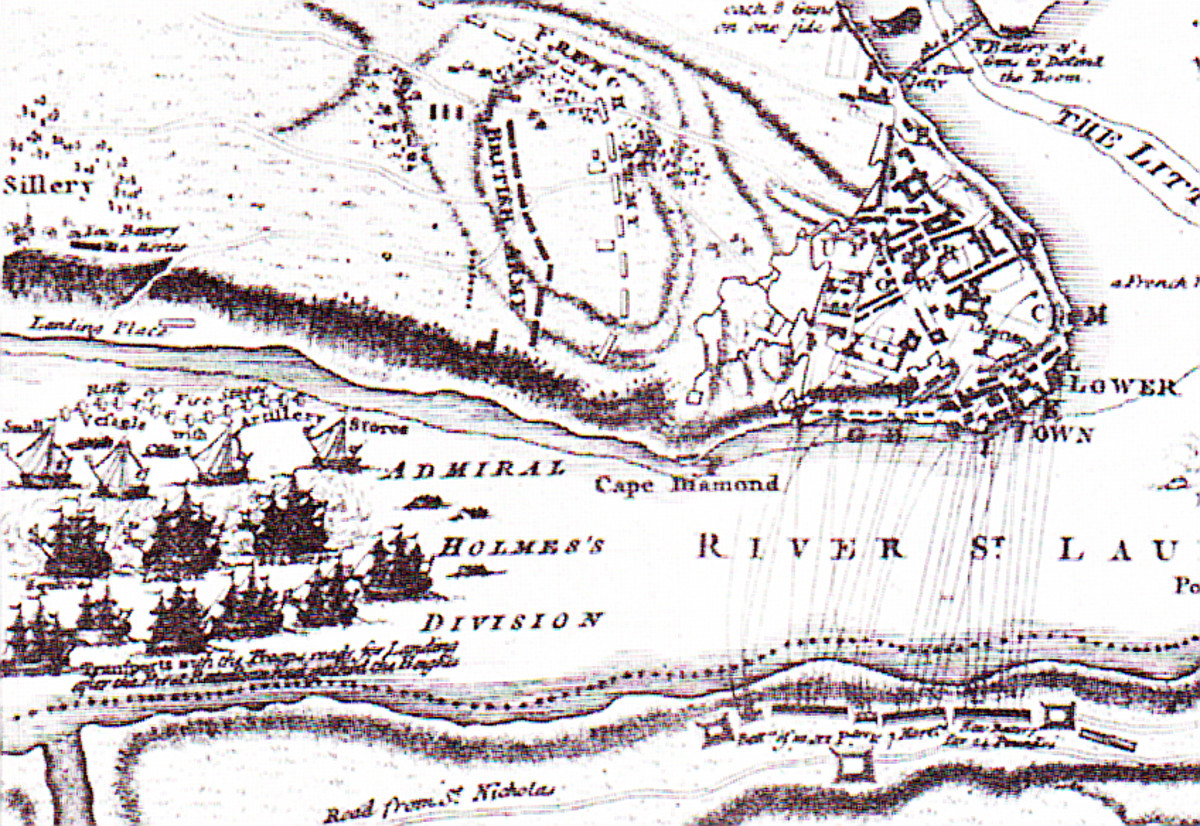
This engraving dates from 1797.
While deemed to be inaccurate, it does lay out the local geography.
From west to east ..
The 'landing place'; the Plains of Abraham meeting of armies; the town of Quebec.
And now our statistics ...

* * *
* * *
Europe 1900

As you would expect, there were a few developments between that 1759 colonial battle involving professional European soldiers ... and the Great War. This made the latter a very different kind of military engagement.
Big things had changed
- Conscription ('the Draft'), early 1800s - Napoleon brought back an invention of the ancients to build massive fighting forces for his European campaigns. The new/old idea was that the European states could now welcome all able-bodied males to get involved in the ever popular war game. War wasn't just a game for professional soldiers to play on a little battlefield anymore !
- Industrial Revolution, 1750-1850 - Machines do things better than people (... well, except when computers use certain operating systems). Large amounts of capital were invested in industrial machines and infrastructure, which in turn led to a concentration of workers living around factories. This led to the necessity of urban sanitation and the concept of 'public health' as the impoverished and sickly workers provided a wonderful medium for disease hosting and epidemics.
- Railways and the steam engine 1800-1900 - This important technology of the Industrial Revolution provided portable power to efficiently transport heavy loads and power factories - free from the natural limits of wind, water or muscle power.
- Aircraft and airships, early 1900s - powered by small gasoline engines, these could provide some transportation, but more importantly, they provided a bird's eye view of the ground below. Previously, only the earthbound horseback cavalry had been available to perform quick reconnaissance on enemy positions and movements for military commanders' decisions.
- Telegraph 1840-1900 and the steamship 1850-1900 - Communication and world travel went hand-in-hand with the expanding industrial economy ... and the existing colonies of the European empires. Modern warships could control the sea lanes or harass enemy colonies 'on a schedule' as long as they could be bunkered (refueled with coal) every 8 or 9 days. Orders and intelligence could be relayed by wireless telegraph. The whole world could now participate in a European war !
- Understanding and regulating the economy - After :
- The works of Adam Smith (circa 1780) and David Ricardo (circa 1800) explaining some aspects of 'economics'
- The experiences of governments legislating elements of the Industrial Revolution
- The experiences of capitalists financing, building, and operating large corporate empires
- Governments and/or rulers, government bureaucracies, and industrialists ... had the new-found ability to focus complex national economies on a single project. In other words, they could create a 'Total War Economy'. From this came the cheerful conclusion that even civilians working in cities away from the battleground were legitimate targets for shells and bombs. Humans were making big progress !
Little things had changed (relatively speaking)
- Chemical industry advances 1850-1900 - Chemical, electrical or heat treating of coal, oil, nitrogen compounds and other materials yielded new industrial chemicals which provided more efficacious ammunition and explosives ... and handy gases such as hydrogen and chlorine.
- Rifling, 1850s - By using new machine technology, fine spiral grooves could be carved into the inside of gun barrels so bullets or artillery shells would spin down the barrel and continue to spin in flight, achieving much greater range and accuracy than musket or cannon balls.
- Smokeless powder, 1850-1900 - more power, less smoke - for firearms, due to the chemical industry's advances. Smokeless powder fired when wet - no one would ever say 'keep your powder dry' again ! More ammunition could be carried because less powder was needed for firing ... new all-in-one metal ammunition cartridges could be smaller and lighter. Barrel rifling and tight physical tolerances on small arms were also possible because the solid residue left by gunpowder was no longer a problem. This new-found gun barrel cleanliness maintained targeting accuracy and reliability during longer battles, and facilitated the use of automatic cartridge feeding/ejecting mechanisms.
- Breech loading weapons with magazines 1850-1900 - Modern manufacturing techniques allowed weapons to be mass produced with much greater precision. The rear end of a mass-produced precision-manufactured rifle cartridge, made from thin metal, expanded momentarily on firing to ensure that all the combustion gases were used to force the separating bullet down the barrel ... then the spent cartridge reverted to its original dimensions so it could be removed from the firing chamber at the breech. With a multiple-cartridge magazine connected to a rifle, a good rifleman might be able to fire 5-10 bullets in less than 15 seconds - before 'reloading' by pulling out the old magazine and inserting a full one. While firing this fast would not be accurate at a distance, it would certainly be very discouraging for an enemy running up to take over the rifleman's position. (After each shot, a British rifleman generally had to eject the spent cartridge and insert the next from the magazine by moving a 'bolt' back and forth in an 'L'-shaped movement. This gross movement after each shot generally meant it was necessary to pause to re-aim for each bullet.)
- Breech-loading artillery using rifled barrels and smokeless powder provided the ultimate in mass production of death and destruction for the modern battlefield. Progress, progress, progress !
- Machine guns 1884-1918 - A quantum leap - from the hand-cranked Gatling gun of the US Civil War to the Maxim gun/machine gun - enabled a stream of bullets to be fired with just one press of a trigger. Conserved combustion gases ejected the spent cartridge, and loaded and fired the next one (known today as 'fully automatic fire').

Old and New Compared
- The old 1759 battle model was standing shoulder to shoulder on a little old European battlefield.
- Beyond 40 yards (or metres), you couldn't really hope to hurt anybody.
- A soldier's firing rate was two rounds per minute.
- Cannon had to be repositioned and re-aimed after each firing.
- With the new 1914 battle model, heavy rifles could provide harassing fire up to one mile away, and fire about 20 rounds per minute with some accuracy.
- Machine guns could sweep a wide area with about 400 rounds per minute.
- The range of heavy artillery was measured in miles.
- Some quick-loading field guns could fire 20 rounds per minute and the recoil disappeared into 'recoil shock absorbers' - so the guns didn't roll out of position when they fired.
New Idea 1: If your soldiers start walking across a flat open field toward the enemy they will be cut down at a great distance.
New Idea 2: Forget about tight formations. They just make easy targets. Let your soldiers spread out and enjoy the whole battlefield !
As you will see - unfortunately - ignoring these ideas: Soldiers would find themselves ordered to walk across open fields and through battlefield constrictions in full view of the enemy !!
With greater firepower, individual soldiers controlled more space

World War 1, French riflemen before trench warfare.
In 1914, the French soldiers above are using newer tactics. You can't see the enemy because their bolt action rifles shoot much farther.Unlike Montcalm's soldiers, they are taking cover. They are still bunched together and you can see a couple of officers behind them, keeping an eye on things. This doesn't look like World War 1, but it is.
One dumb thing the French above were doing : wearing bright red trousers with their dark blue coats. At least it looked spiffy. You should have seen the Zouaves ! The French army had their colours done again and got into more subdued hues pretty quickly.

This is a hand-coloured postcard, but you get the idea ..
World War 1: Cambrai battlefield - before trench warfare. Below, in the graphically-muddy newspaper-type illustration, you can see a more traditional battle early in the war.

The Germans' invasion strategy for France was to swing counter-clockwise across Belgium toward France like a big door - Luxembourg was the 'hinge'. The man on the right side of the swinging German 'door' was supposed to 'brush his sleeve on the English Channel'. The Germans did not get that close to the Channel, and Dover-Calais remained a viable route for transporting troops and supplies from Britain - along with other English Channel ports.

The British had an expeditionary force in western Belgium - to enforce Belgian neutrality and to help defend France from invasion. These English/German encounters in Belgium were the last great exhibitions of the fine marksmanship and concentrated fire, of professional British soldiers, using bolt action rifles. The tactics would be changing significantly as the war continued.
As the Great War began, half the time the various armies were just trying to find each other in the forest, behind hills, etc.
(In contrast, on the Eastern Front - between Russia and Germany in the area of Poland - the battles were free-ranging across open terrain for most of the war - trench systems were seldom necessary in the east.)
This newspaper illustration above shows 'guns' in action. Did you ever see the movie 'Full Metal Jacket' ? ...
'This is my rifle ... this is my gun.
This is for shootin' ... this is for fun.'
'Guns' = artillery ... which classically comes in three flavours :
Traditional 'field guns' - sort of visible above - were towed around by horses and positioned like cannon for battle on the field. The shells followed a relatively flat, direct trajectory.
Howitzers - Napoleon or someone was fiddling around and found out that a shell fired at an upward angle of 45 degrees ... travels the farthest. Howitzers hit targets which might be behind hills or otherwise hidden from view. While the field guns above have front row seats, Great War howitzer crews usually didn't have to worry about hand grenades or machine gun or rifle bullets - because they enjoyed life far behind the lines. Well ... except when they were subject to pre-emptive 'counter battery work' by enemy howitzers.
Mortars - We've all seen the small ones on TV. Some bigger ones were for throwing heavy shells from one set of trenches to the other. Why bother with large trench mortars ? Their 'big bombs' could be fired fairly close to the enemy BUT from under cover to an enemy under cover. The most pleasant thing about them was that their slow incoming rounds could often be heard and avoided if a soldier was lucky.

Fun with a trench mortar
The Famous French 75s in the battlefield !

The thing about these 75 mm field guns was they were quick firing. A crew could fire off a shell every 2-3 seconds.
Open the breech.
Insert shell.
Close breech.
Bang !
Open the breech, spent shell casing pops out.
Reload.
During a field battle on level ground, a battery of 75s had amazing firepower.
.. Wow ... an 'aeroplane' ! How many soldiers have seen an airplane before - yet no one is looking up?
But look again ...
HORSES! Lots of them ! And the war's voracious appetite for horses never really diminished in spite of new technologies.
The 'Entente' ... Britain, France, (and sometimes Russia, USA) etc. had the reserve manufacturing capacity to make greater use of motorized transportation later.
However, the 'Central Powers' ... Germany, Austria-Hungary, (and sometimes the Ottoman Empire) etc. and the many smaller theatres of war always took a terrible toll on horses and other draft animals, including dogs.
Desperately chasing elusive German quasi-guerillas in east Africa, imported horses taken into areas where the tsetse fly was endemic had a life expectancy of 4 weeks.
As I continue to build the case for more efficient transportation systems for another page, notice the big haystack. Hay, oats, etc. were transported to the battlefield in great quantities to 'fuel' the horses. Some sources suggest the tonnage of ammunition, and the tonnage of fodder, hauled into the war zone ... were roughly equivalent.
How war technology and ideas evolved on the western front ...
As you might expect, no one really planned things the way they turned out. In most cases, when one side used a new weapon or technique, the other side quickly adapted - unless their hard-headed military dogma initially slowed progress (oh, hello Britain!).
Generally, the Germans had better weapons and techniques in the beginning ...
- Storm troopers were elite soldiers who were 'empowered' to make decisions on the spot as they advanced in multiple groups of fewer than 10 soldiers.
- Storm troopers advanced with gathering momentum toward their objectives ... pockets of resistance were ignored - to be worn down later by regular infantry or artillery.
- The German military saw the benefits of the machine gun for their armed forces before the war and really stocked up on them ... and they had better artillery, too.
Generally, the British military investment had been focused on seapower to protect its world-wide empire. It was protected from land invasion by 'the stopping power of water' and was not well-prepared to fight a European land war ...
- Empowering ! ... and trendy 'loose/tight' principles for soldiers ?! ... well, it just wasn't right ! 'It would be like letting the monkeys run the zoo !' (a 1983 quote)
- The British rifleman is the finest in the world ! Cavalry is what is needed for decisive victory ! Machine guns would undermine our war-fighting traditions and they might even be unethical.
- However, as the war stumbled along, the British military finally mastered modern technology and tactics and surpassed Germany.
- Kitchener - the guy with a moustache pointing sternly from recruiting posters - a career military man and Secretary of State for War ... presided over a massive expansion of the British Army from 20 to 70 divisions (division = about 12,000 soldiers) during the first two years of the war.
Kitchener used the idea of 'Pals Battalions' (A battalion is about 1000 soldiers - a small, complete fighting unit.) The 'pals' were a group of sportsmen, or sometimes a group of similar occupation - most often they were from the same city or geographical area. Local social pressure acted to influence individuals to volunteer with their pals. On the battlefield, this resulted in the strong cohesion and loyalty desirable in military units.
Generally, the French (and Belgians) expected the Germans to pop by for an invasion every few decades ... and had pre-invested heavily in forts and citizen soldiers ... Important point : they were fighting to defend their own lands and homes.
One of the first lessons of the war was that permanent fortifications could be bypassed, starved out, or smashed by huge German Krupp-built siege guns.

It's a small world, after all ... it's a small, small world

The large 1915 newspaper map is included below because it offers so much easy-to-understand information about conditions early in the war. It was created before computer graphics !
For most of the war, the 'Western Front' extended in a continuous line of trenches : from the northern border of Switzerland, continued obliquely (west of the France-Belgium border), then north at around Lille to the last 'k' in Dunkirk. The Germans held, and took advantage of, most of the important mining and industrial land of France and Belgium during the war.
If nothing else, you can conclude that this 'battle for a continent' was going to involve more than the 9000 soldiers employed on the Plains of Abraham !
Notes on the map:
'The Great trade route to Russia and the East' is written on the Mediterranean Sea ... The British tried to seize 'the Dardanelles' (key straits in Ottoman Turkey) through Kitchener and Churchill's diversionary Gallipoli campaign, so that Russia could be resupplied by sea. The German navy controlled the Baltic Sea, so the only other choice was the Mediterranean. This didn't work out as planned.
The notation of 600,000 at Great Britain notes in small print : 'excluding India and colonies ' . World War One pulled in many colonial resources, particularly from the empires of Britain and France. There is a fairly complete list of participants at the end of this page. The battles and tactics I describe include the colonial troops of the many nationalities under French and British command.
Technical evolution of infantry ...
- Soldiers had excellent firepower ... modern accurate rifles with preloaded magazines of about 5-10 rounds.
- However, machine guns were often placed in staggered and sheltered positions to defeat the firepower of the advancing infantry.
- The Germans made the decision to dig in using easy-to-defend trenches so some troops could be taken away to fight the Russians on the Eastern Front.
- Until this point in history, barbed wire had been for cattle. Barbed wire entanglements were placed in front of the trenches to slow down attacking enemy infantry - to help defend the trenches. Paths were left through the barbed wire entanglements to allow for infantry attacks FROM your own trenches TO the enemy trenches. Your defending machine gunners only had to target these specific paths in the wire. In other words, the paths were like turnstiles used to control crowds. You set your machine guns up to target the 'turnstiles'.
- Hand grenades, grenade launching rifles, flamethrowers, and trench mortars were used in efforts to destroy the machine gunners and other enemy troops. During a battle, one source suggested, a working machine gunner would live for about 5 minutes.
- To break the wire for an attack, high explosive artillery shells were used ... sometimes successfully. Bangalore torpedoes (long pipes filled with explosives) could sometimes be slid along the ground under the wire and detonated to clear a path for the infantry.
- Generally ... all routine activity ... troop rotations, barbed wire placement in No Man's Land, and trench raids were conducted at night. It was too dangerous to be sighted by the enemy by daylight. The daytime was for 'sleeping'.
- Learned the hard way : There was really no way for infantry to successfully attack a trench protected by machine guns with barbed wire entanglements in front.

World War 1 British wiring party with screw-in stakes.
This photograph is taken behind the front lines because :
- The soldiers are walking above ground level.
- They are going to do some wiring in daylight.
- Artillery is working in the background at the left.
Besides their rifles, packs, picks, shovels, coils of wire, etc. the soldiers are carrying an invention that saved many lives. Most activity - particularly placing barbed wire in No Man's Land - was done at night to avoid becoming a target. However, noise could invite enemy parachute flares which would turn night into day for those found in No Man's Land. The curly-bottomed fenceposts could be silently turned into the ground by inserting a bar through the 'eye' on top - thus avoiding the noise of trying to drive posts in with sledge hammers ... and a sniper's bullet.


A familiar sight for Canadian troops was the Cloth Hall at Ypres.
Featuring towers which could be used to monitor enemy troop movements
and to 'spot' artillery, it was only a matter of time before it was reduced to ruins.
Technical evolution of the artillery and the 'air war' ...
- Artillery usually had to be 'registered' in new locations by observers ... The gunners were often too far away to see their targets or to assess their fire.
- Paraphrasing the observers (a lot) ... 'a little to the left' - kaboom ... 'now up a bit' - kaboom ...'Perfect ! fire for effect' - lots of kabooms.
- Artillery observation was done from hills, trees, steeples and eventually tethered observation balloons filled with hydrogen above friendly territory.
- Then enemy aircraft started coming over to shoot down the observation balloons in flames.
- Then observers started wearing parachutes in case they had to leave before their shift was over.
- Then friendly planes, shot down the enemy planes, which were shooting down the observers.
- Then enemy planes, shot down the friendly planes, which were shooting down the enemy planes, which were shooting down the observers.
- Finally, specialized observation aircraft and fighter aircraft began their own separate 'war' above the battlefield.
- Sometimes, if things were quiet, fighter aircraft would bomb or strafe enemy ground positions.
- London and Paris got their first bombing by large German biplane bombers in 1917 ... Total War ... included civilians far behind the lines.
- The Secretary of State for Air in Britain sent a message to the Chief of Air Staff 'I would very much like it ... if you could start up a big fire in one of the German towns. If I were you, I would not be too exacting as regards accuracy in bombing railway stations in the middle of towns. '
- 'Tactical' (military target) bombing had evolved into 'Strategic' (city) bombing before the end of World War 1 - the grandfather of 'Mutually Assured Destruction' 50 years later.

Everyone and his horse is out to watch the launch of a tethered German observation balloon. Once aloft, an observer connected via a telephone wire to the ground could see 60 miles under good conditions and correct the aim of artillery. More than just tasteful decoration, the Maltese crosses are designed to help prevent 'friendly fire' attacks from German aircraft.
('Fun' fact : The Germans' unique Pariskanone rail-mounted gun sent shells to an altitude of 130,000 feet - requiring the Earth's rotation and curvature to be factored in to the targeting calculations. By the end of the war, a range of 100 miles was possible with this type of gun with local spies providing feedback on where shells landed.)
Things get really fancy ...
Observers in aircraft kept track of all changes on the enemy side, taking aerial photographs for commanders to review. Weather permitting!
The arrangement of things starting from No Man's Land on the British side :
- Barbed wire entanglements
- Front line trenches
- Often second and third line combat trenches - in case the first line was taken ... with numerous connections between them. The trenches were often named in alphabetical order.
- Then, extensive honeycombs of 'communications trenches' for moving and massing of troops, communications, and storing food and ammunition supplies. In theory you could walk from Switzerland to the North Sea without ever leaving this elaborate maze of ... um ... ditches.
- Then, heavy artillery batteries, some organized medical treatment, heavy transportation systems and supply massing areas. ('Bricks and mortar' hospitals were often near the coast.) 'Rest' billets for soldiers taking a duty turn away from the trenches were often still within range of lucky strikes by heavy artillery shells.
- Command and administrative support were in the rear and safe. Thank goodness.
- Orders and information were communicated by pigeons, dogs, human runners, telegraph and telephone. If the enemy shelled, the telegraph and telephone lines were destroyed. Pigeons didn't like to fly in damp overcast weather.
- Sometimes the British would shell for days before an attack. Continuous rapid shell explosions were termed 'drumfire' and sometimes their frequency could be approximated by chattering one's teeth. This means ... sometimes over a million of artillery shells were fired in a few days.
- With great physical and psychological hardship the Germans (for example) survived in reinforced concrete bunkers which might be 3 stories into the ground. They lived this way under bombardment for days at a time, completely cut off from the world, including food, water and medical care. The British were always amazed to see the Germans pop up with machine guns right after the shelling stopped, and effectively defend against an attack. Often during intense shelling ... the Germans had resolved that active death through bitter fighting was better than passive death by shelling. So, freed from their bunkers ... they finally had control over their fates and fought hard.
- If the British had the right shells ... High explosive was used to break the bunkers and cut the wire. Air-burst shrapnel was used to kill troops. A variety of different gas shells would keep the enemy off balance.
- Sometimes they had the right shells, used enough of them in the right way, and actually co-ordinated barrages with friendly troop advances on the enemy..
- But often, up to 1/3 of the shells were duds early in the war, and high explosive shells went deep into the mud and did nothing except chew up the land which the infantry had to cross.
- As you can imagine, there are many practices I am leaving out for ... brevity. The Germans got really elaborate with 'defense in depth' rather than just a few frontline trenches holding 'all their eggs in one basket'.
A Map from the 1920s - mostly of the British sector during the war.
Varying only 20 to 40 miles (maximum) in position from east to west, the pink dashed lines show the positions of fixed trench lines ... as well as their dates of use.
The orange area, including West Flanders is western Belgium.
The pink area is France and you can see Dunkirk on the coast of the North Sea.
West 20 miles from Dunkirk is Calais (off the map). From there it is only 22 miles to Dover.
The yellow dashed line shows the maximum extent of Germany's quick but objectiveless offensive in the spring of 1918.
Railways : black/white alternating ... double track.
A single black line is a secondary railway line ... or a river.
Canals are black lines with hatching on one side.

- A reference suggested that great battles were fought at Ypres (Belgium) because German occupation of the nearby coastline could affect British dominance of the North Sea/English Channel waterway. The British were concerned about U-boat torpedoes, naval shelling, and particularly mining of the transportation routes from England to the war zone. A mine had sunk Kitchener's warship, killing Kitchener and almost all the crew while he was on his way to Russia in 1916.
- Finding the correct pronunciation of 'Ypres' counter-intuitive ... (pronounced: EEpr) ... the British generally referred to it as 'Wipers'.
- In Flanders, the Germans had long held the heights overlooking the artillery-churned soupy mud occupied by the British. Having no British divisions handy to take Passchendaele (150 feet above sea level) and feeling the need for a battle, Field Marshal Sir Douglas Haig, commander of the British Expeditionary Force sent in ANZAC (Australia & New Zealand Army Corps) forces. They ran into machine gun fire from all sides, were unable to get through the wire, and withdrew. Canadian commander General Sir Arthur Currie was then called on to send in the Canadian Corps and he did so under protest. There were 16,000 Canadians killed and wounded during the Passchendaele Battle (or Third Battle of Ypres) in exchange for 5 square kilometres of mud and 3 Victoria Crosses.
Geography, soil science, and 'public health' on the Western Front
Before :
- Much of the Western Front battlefield had been farmland, scattered with woodlands and villages.
- Natural drainage patterns had formed over centuries.
- Farmers worked their fields by plowing furrows, and also deeper rigoles from time to time, to retain or drain moisture as needed.
- The woodlands also helped modify drainage patterns and reduce erosion.
- In Flanders (particularly that area of Belgium near the English Channel) the water table was often near the surface.
- Livestock manure was used to maintain the fertility of the soil.
After :
- High explosive shells disrupted the natural drainage patterns, and shellholes quickly filled with rainwater.
- The incessant shelling also destroyed all trees and vegetation on the battlefield.
- After an attack, it was usually impossible to evacuate the wounded from No Man's Land by day.
- Freshly created war graves were opened by new shelling and unburied dead humans and animals were scattered by the shelling.
- Trenches = ditches and they often filled with water because natural drainage patterns no longer existed. In some essential cases 'breastworks' (above-ground trenches : mud forts) were built at key points because of the high water table.
- The soil of this former farmland had already been well treated with decomposing livestock manure.
- Penicillin had not yet been invented.
- Advancing soldiers were under orders not to stop to attend to the wounded. Advancing soldiers took cover in water-filled shellholes as needed.
- Surgical intervention was generally far to the rear, inaccessible during a battle, and therefore hours away and sometimes days away.
- ... So bacterial infections were a bit of a problem ...

Stretcher bearers.

Village of Passchendaele before/after Third Battle of Ypres
This is the effect of about 500,000 shells on about 1/2 square mile.
How to be a winner !
British Strategy, version 1.0 ... Breakthrough !
- Achieve a breakthrough in the enemy lines and use the cavalry to decisively exploit the weakness behind the enemy - in other words, 'fight the last war'.
- To avoid the deadly fire of enemy artillery and machine guns on both flanks, the breakthrough must be several miles wide.
- On to Germany before Christmas !
British Strategy, version 2.0 ... Attrition
- Germany is literally being starved for food and war materiel by the Royal Navy North Sea blockade.
- Austria-Hungary and the Ottoman Empire are not competent allies of Germany.
- Germany is alone against Britain and France - and the Entente has access to American financing and war materiel. American companies are making good money for their efforts.
- Use heavy shelling and repeated massed attacks. Kill more enemy soldiers than you lose.
- Eventually surviving Entente soldiers will outnumber surviving German soldiers in a 2 to 1 ratio.
- The Entente will have won !
British Strategy, version 3.0 ... Let's see ... Breakthrough? nope ... Attrition? nope ...
'The Tanks are coming, the Yanks are coming !'
- Gasoline powered tanks, conceived separately by both the French and British around 1915, carry heavy machine guns or light field guns ... and lead infantry over barbed wire and across enemy trenches. The Germans are completely surprised and have nothing similar. Tanks break down in battle and becoming sitting ducks ... the crews decide to use up their ammunition while they are sitting there ... and terrified Germans still run up to them to surrender !
- The German army is fighting alone without decent allies, worn down ... and the civilian population is literally starving and demoralized. During the war, the mail censors keep their fingers on the psychological pulse of the armies and report to their superiors on soldiers' morale and gripes. It turns out that the British and French soldiers have had a bellyful of war and just want it to end. The French soldiers mutiny (really a very disciplined sit-down strike) and get a commander sacked and demand that they be treated better than beasts being sent to the slaughterhouse (Chanson de Craonne). About fifty are executed with full division march-pasts by the bodies - as an example of what better treatment looks like. 'You don't let the monkeys run the zoo.'
- This is a strategy ?
- The Americans have joined the war really late in April 1917. The recent German promise of unrestricted U-boat warfare against neutrals was one thing ... but the last straw was being shown secret British decodes of German diplomatic feelers to Mexico about an alliance and an attack on U.S. soil ... if the U.S. were to enter the war. 'Fresh man in the mow !' as we used to rejoice on the farm. Certainly as smart as any British Commander at the beginning of the war, U.S. Commander General Pershing doesn't know what his troops are in for. He still thinks riflemen and mobility will win the day - i.e. 'fighting the last wars' ... in his specific case ... against Geronimo, and most recently 'Pancho' Villa in Mexico (used as a prototype for The Frito Bandito). The Americans save shipping space by using French Renault tanks and French equipment and British helmets. They want to fight as an independent army. The US Army in Europe would have reached critical mass only by 1919, so their chief impact is psychological on both sides.

World War 1 British tank
The British tank above is not that impressive, is it ?
If you were a German machine gunner, you could stay behind cover and barbed wire and disable all the soldiers to the right of the tank almost immediately. Unlike the dead soldiers, the tank would continue to grind and screech toward you at 2-3 miles per hour ... over the barbed wire ... over the trenches ... until the heavy gun in the side turret was pointed directly at you.
All tanks break down a lot, but the first ones set world records for breakdowns and getting stuck in the mud. They were hellish to work in (noise & heat), and exploded into flame, burning the crew to death, when the gasoline tank was hit. (In World War 2, Germans referred to some British gasoline-fueled tanks as 'Tommy Cookers'.)
But early tankers learned quickly ... Already, you can see a design 'upgrade' to prevent grenades and bombs from disabling the tank from above ... that little peaked roof made of fencing. Tossed grenades would bounce off and a larger bomb could not be placed directly on the steel roof - so its blast would be diffused.
The End
Everything seemed to fall apart at once. Workers, other civilians, and low-ranking soldiers everywhere were fed up.
The Czar had previously been tossed out in Russia.
The Kaiser - the emperor of Germany - could be next.
For at least the last couple of war years, Germany had actually been run by a military dictatorship.
There could have been a Russian-style 'socialist revolution' in Germany.
Instead, there was a German 'revolution at the top' and Kaiser Bill got out of the way.
President Wilson's Fourteen Points were accepted by a new German chancellor and the fighting stopped.
No one had really won decisively on the battlefield. The German soldiers marched home as if a victory had been won. Most of Germany was never occupied by Allied soldiers
A few years later, to get German citizens in the right frame of mind for World War 2, they were told that the faithful, long-suffering World War 1 soldiers (among them, a cheerless Corporal Adolf Hitler) had been stabbed in the back by German politicians.
The following statistics demonstrate the relative industrial capacity of
the Entente / US ... (the 'Allied Powers') :
| British tanks produced by war's end (crew: usually 8) | 2500 |
| French tanks produced 1918 (crew: usually 2, but up to 8) | 5000 |
| German tanks produced by war's end (crew of 18!) | 20 |
| British, French, US aircraft production 1918 | 11,200 |
| German aircraft production 1918 | 2000 |
* * *
War Cannot Be Won
Central Powers : Military deaths / Military wounded
| Austria-Hungary * |
1,100,000
|
3,620,000
|
| Bulgaria |
87,500
|
152,390
|
| Germany * |
2,036,897
|
4,247,143
|
| Ottoman Empire * |
800,000
|
400,000
|
* Empire broken up as a result of the war.
European countries of Entente/Allied Powers : Military deaths / Military wounded
| Belgium |
38,172
|
44,686
|
| France |
1,397,800
|
4,266,000
|
| Greece |
26,000
|
21,000
|
| Italy |
651,010
|
953,886
|
| Montenegro |
3,000
|
10,000
|
| Portugal |
7,222
|
13,751
|
| Romania |
250,000
|
120,000
|
Russia *
|
1,811,000
|
4,950,000
|
| Serbia |
275,000
|
133,148
|
| England, Scotland, Ireland, Wales |
885,138
|
1,663,435
|
* Empire broken up as a result of the war.
Non-European countries of Entente/Allied Powers : Military deaths / Military wounded
| Australia |
61,928
|
152,171
|
| Canada |
64,944
|
149,732
|
| India |
74,187
|
69,214
|
| Japan |
415
|
907
|
| New Zealand |
18,050
|
41,317
|
| Newfoundland |
1,204
|
2,314
|
South Africa
|
9,463
|
12,029
|
| United States |
116,708
|
205,690
|

An early World War 1 editorial cartoon. Published, Chicago 1915
In the left background, a village and church are being shelled.
In 1915, when this cartoon was published in the US, the worst was yet to come.


