Showing posts with label light railways. Show all posts

2015-01-24

Railways in War, Part 3 - Railways To and From the Great War Battlefield


German 'war engine' built 1861
In branchline service in the early 1900s, this German locomotive, which was built in 1861, was probably typical of those which were 'still good enough to pull German troop trains working as 'war engines' when Belgium and France were invaded.

South-Eastern & Chatham Railway, Great War
Using equipment like this in south-east England, British railways were hustling soldiers to ports on the English Channel so they could join the British Expeditionary Force in France and Belgium.


Western Front area, railway system
The map above shows the "natural pattern" of the railways before the war started, with the darker lines representing double track railways. As you would expect, drawing "No Man's Land" through the countryside disrupted the pre-war flow of standard gauge railway traffic.

So transporting thousands of troops, supplies, weapons, and ammunition to the active war zones required adapting railway lines and operating practices. Then, with advances or retreats, the railway traffic patterns would change again ...

Great War 1914, Western Front, British Expeditionary Force

The map above shows the division of part of the Front in the first months of the war. Brackets indicate who commanded which sections of Front. Initially it was Field Marshal Sir John French commanding the small British Expeditionary Force ... his zone appears as (French) on the map near Ypres, Belgium.

As the war 'progressed', and the BEF grew, it took over the remaining area north of the Somme River from the forces of France. The Somme runs through Amiens, Peronne and St. Quentin.

So ... the northern end of the Western Front running into Belgium ... became British and included the Canadians fighting at various locations ... including in 'Flanders Fields'.


Great War Beaumont Hamel station
'Train Service Suspended!' was the contemporary title. Beaumont Hamel 'station' in 1917. A damaged passenger car can be seen still on the rails, to the left of the picture.


Great War French troops shell light railway
Narrow gauge: Here two French soldiers are using a cross bar attached to a wire to pull an artillery shell to a battery as another soldier steadies it. The shell dump behind a ridge is purposely not in the direct view of the enemy. As always, smooth low-friction rails make heavy load movement easier.


Great War 'flying pig' dump French sector
'Supply trains' and 'ammunition trains' were generally convoys of horse-drawn wagons hauling toward the battle area. Trucks using gasoline motors were also beginning to appear near the Front during the war. Here trench mortar 'aerial torpedo' bombs sit at a trans-shipment point between wagons and a railway in the French sector.


Great War artillery shell storage, railways
As greater efficiency was demanded, transfer areas such as this were set up ... far to the rear. A narrow gauge railway, will take the shells closer to the battle area where the artillery batteries are located.

Feeding the Artillery

  • In August 1914, British field guns had a total of 1000 shells available at or approaching the front lines. 
  • In June 1916, EACH 18 pound (shell weight) gun had 1000 shells ready for firing at its gun position. These 18-pounders often operated 2 miles behind the active front. 
  • In 1917 during the summer, 18 pound shell use reached 1,000,000 shells fired PER WEEK. 
  • Just before the Armistice, Britain had over 10,000 guns, howitzers and trench mortars in the field.

The use of railways was more than just a matter of efficiency. Using Canadian experiences near Ypres, Belgium as an example ... a number of factors made conventional supply trains of horses or mules and wagons very difficult.
  1. The battlefield was low-lying farmland which was flat and usually drained slowly.
  2. The rains were unusually heavy.
  3. With repeated artillery bombardments all of the natural drainage was disrupted. Water pooled in shell holes and saturated the surrounding soil. The water table rose to meet the surface soil in places.
  4. With the pounding of heavy human and vehicular traffic "higher" pathways turned from grass, to mud, to mud with watery ruts, to quagmires.

Mules and horses suffered terribly during World War One.
Where possible, narrow gauge railways were laid. With multiple axles spreading the weight of the payload out, the railway could often "float" on the mud. The use of special tracks, featuring metal "cup" ties also distributed the weight broadly. With the mules and wagon above, all the weight is being forced down on just a few points - hooves and wagon wheels.

A Frenchman by the name of Decauville developed his idea of modular ready-to-run railways which could be quickly laid and taken up without demanding all the skills of professional railway maintenance crews. A farmer and distiller with a large operation, Decauville's first efforts were used on his own farm for transporting the harvest from the fields and hauling manure. The small, stable railway 'footprint' allowed him to haul large quantities of commodities without the damage to his fields which would have resulted if equivalent horse-drawn wagons were used.  He thought there was no reason why this technology couldn't be employed in factories, mills, mines and other facilities where a full-scale conventional railway would never have been justified.

* To fully grasp 'The Decauville Concept': Go to a toy store and look at a 'toy train' with all the rolling stock and track sections in one box.

* Handy tip if you build your own trench railway: A track segment with a permanent LEFT curve, becomes a track segment with a RIGHT curve if you turn it so the other butt end faces you.

Because little metal pieces tend to get lost in a muddy battlefield, having the track sections in "one piece" with perhaps two standard bolts to secure track sections together met the needs of the armies well. It also meant unskilled labour could be used to do most of the tracklaying.

Below are two different proprietary connecting systems. Notice that the metal ties of the LeGrand system are cup-shaped underneath to float better on soft ground. In the top illustration, two men are moving a section of track which probably weighs just over 200 pounds.

Great War modular light railways
Track switches are relatively complicated, delicate pieces of track and if their tapered 'switch points' are damaged, derailments occur with regularity. It was possible to buy 'modular' left, right or three-way track switches. However, a simpler solution was to place special pivoting wheelsets under your load and use a rather unconventional turntable ...


Wheelset with pivoting load-bearing girder.
The Internet: At one point, I was emailed by a Florida-based archaeologist who was contracted to work as a consultant during the recent enlargement of the Panama Canal. He was requesting a published reference for the item above, because they had dredged one up during the ongoing reconstruction work.


Great War diagram, cast iron turntable, rotating wheelsets light railway -
track and turntable viewed from above.

In the drawing above a (L)oad, which looks like a pole, is being transported on two pivoting wheelsets. The load is making a 90 degree left turn.

The leading wheelset has run onto the cast iron turntable, has been turned 90 degrees ... and has rolled off toward the top of the illustration. The trailing wheelset will be next.

Needless to say, this system worked best in low traffic areas. But it was simple, robust and required little maintenance.


Great War installing cast iron turntable on light railway
Here troops are installing the top plate of one of these turntables. In this case, the turntable has no 'rails' in the top casting ... the steel wheels will simply sit upon the smaller raised circle ... I am guessing.


Great War light railway, potable water tankcar
There was often plenty of water in the trenches, but it was undrinkable. Above, an armoured gasoline-powered locomotive has taken a water tankcar for filling with clean water for the troops.

Gasoline cans were used to carry both water and gasoline by hand to the front lines. As the cans were usually not rinsed, potable water often tasted like gasoline.

Great War 'iron ration' dump

Beside a main line railway track is a large storage area for military canned provisions.

Some British Army 'iron ration' favourites: bully (corned) beef, hard tack (like dog biscuits), canned stew or vegetables, 'plum & apple jam', canned bacon.

At the left, troops are scaling the pyramid of food. Horse-drawn wagons and a primitive truck can be seen ... ready to take the rations forward.


Great War light railway mules for power
In 1917 a light railway is used to haul ammunition, and a few riders, behind Canadian lines at Vimy Ridge.

There are several possible reasons why mules are being used instead of a locomotive ...

  • On a steep grade ... 24 horseshoe to roadbed adhesion ... is higher than ... 4 steel wheels to 2 steel rails adhesion. (A light locomotive's wheels would just spin.)
  • Locomotives may have been in greater demand in high traffic areas.
  • As mules don't give off  black smoke, enemy artillery spotters will be slow to spot this train as a target.

The use of traditional coal-fired steam locomotives was very limited near the front midway through the war. At this stage, both sides were using aerial surveillance and the location of most major enemy installations was well known. Black smoke to aim at would just be 'icing on the cake'.

In other artillery developments ... Flash spotting with acoustical ranging was sometimes used to pinpoint the location of enemy artillery batteries ... so counter-battery fire could be directed effectively.


Great War French observation aircraft
A French observation aircraft in 1916 - weather and daylight permitting, of course.


Great War wireless at artillery battery
Using a wireless radio, aerial observers could sometimes adjust the fire of artillery batteries. In this posed photo, the battery commander relays correction information with a megaphone.


Great War light railway at the rear
This is perhaps an example of an out of the box 'modular solution'. Thanks to Frank Sharp, looking in from  England, for helping me identify this as a Hudswell Clarke G class locomotive.

Far behind the Canadian lines near Vimy Ridge. Look ... trees !


Great War, Chinese, Labour Corps duckboards
Chinese Labour Corps personnel unload duckboards from mainline railway cars. The wartime photo caption notes that the Labour Corps was not used in the 'danger areas'. The Great War was a truly global war, with all the great powers drawing in soldiers and labour from their colonies. The firing of a shell or launching of a torpedo often created unpredictable 'danger areas'.


After the Battle

Great War Canadians Vimy Ridge light railway

Contemporary title: 'The Ever-Memorable Exploit of the Canadians on Easter Monday 1917'

Sorry about the seam and the odd horizon - many of these battlefield news photos are not aligned well. This panorama shows modular light railway track, push-carts for evacuating the wounded, and the common practice of using recently captured enemy soldiers as stretcher bearers.


Great War battlefield graveyard, duckboards
Duckboards lead to a battlefield cemetery. In active areas of the Front, the ability to have proper grave observances such as this was rare. With constant artillery barrages and the shifting Front, interments were often temporary - another health hazard. After the war, special crews went over battlefields and huge memorial ossuaries were filled with human remains.


Great War walking wounded evacuation by rail
Walking wounded board regular mainline cars, likely for treatment and rest near the Channel or in England. Fatigued British soldiers often hoped for a 'Blighty One' ...  translation: an 'England Wound'. The most desired outcome, for many experienced soldiers, was a minor wound which made them permanently unfit to fight.


Great War gasoline locomotive light railway stretcher evacuation
A gasoline powered locomotive prepares to depart with stretcher cases.

I retained the horizon on the following photograph to preserve the original detail. 


Great War field hospital stretcher cases.
After the final German offensive of the war, the badly wounded await evacuation by rail at a field hospital.

*  *  *


At a dressing station where first treatment was given.


No doubt they'll soon get well; the shock and strain

Have caused their stammering, disconnected talk.

Of course they're "longing to go out again," -

These boys with old, scared faces, learning to walk,

They'll soon forget their haunted nights; their cowed

Subjection to the ghosts of friends who died, -

Their dreams that drip with murder; and they'll be proud

Of glorious war that shatter'd all their pride . . .

Men who went out to battle, grim and glad;

Children, with eyes that hate you, broken and mad.


'Survivors'
 written by Siegfried Sassoon at Craiglockhart, 1917


Cold and wet in yet another French winter ... these veteran soldiers are posing, under orders, for an 'embedded photographer'.

If they knew you were in their gaze today ...

Some might be tickled to learn ... that even 'Old Fritzie's' great-great-grandchildren might see their picture ...

And they might be interested that today many Germans would be able to understand 'The King's English' written here ... displayed through 'a kind of telephonic, electrically-lit, typewriter-book'.

Some might want us to understand why they went to war ... why they continued to fight ... and to remember their accomplishments, and hopes for the future.

Some might want us to try to comprehend their personal experiences ... and to see how they finished their lives - hours or decades later.


But if they really believed you saw them there right now ...

looking in a century later ...

they would wave their arms... and shout ... and cheer ...

and the winter chill would be gone for a while.


2015-01-04

Railways in War Part 2 - German railway preparations for the Great War (World War One)

The Man of Peace

In the summer of 1914, an American journalist and author, Roy Norton (1870-1942?), was travelling in Germany, having spent a year in that country and the previous ten years in Europe.

In the final weeks before the beginning of the the European War... the Great War ... World War One ... his final observations included Germany's military preparations ... and how its citizens were incited by the government to suddenly go to war. He made several references to Germany's war railways during this period which appear below.

Soon French, British - and notably for this website: Canadian railroaders sent to Europe ... would be working against this sophisticated wartime transportation system of Germany's.

Norton's article "The Man of Peace" was published in the series Oxford Pamphlets 1914-1915. These were articles which worked to explain, justify, and promote Britain's involvement in the war. While this website and other accounts focus on the Western Front in France and Belgium ... "The Only Front is the Western Front !" ...  this was a war which was being fought by the allies and colonies of the European great powers ... all around the world ... in Africa, South America, Asia, and the South Pacific.

Norton's "Man of Peace" was Germany's Kaiser Wilhelm II on whose shoulders he squarely placed blame for the war.


Kaiser Wilhelm II formal state portrait, 
probably circa 1890.

Prussia and the German Empire circa 1900

A map of the various states and kingdoms which united to form Germany ... published circa 1900. Main railway lines and rivers are shown on the map. Initially there were numerous private railways in Germany, and some Germanic states had their own railways as well.


A Quick Survey of the German Railway System


A British book on 'Modern Germany', published in 1905, devotes a chapter to German railway development. It presents German Lessons for the improvement of Britain's railways ... and economy ... and legal system ... and government bureaucracy ...

Railways were a 'British invention' and the Germans imported the technology along with the idea that private companies would usually furnish the capital and operate the lines for a profit. Eventually in such a system, secret tariffs evolve ... which allow railways to charge more for captive traffic (e.g. your neighbourhood coal mine) and less for traffic they wish to win. Strong railways hammer weaker competitors with predatory pricing. There is generally no 'transparency' for less significant consumers - for example, small shippers or even individual railway passengers. Eventually, only the most shrewd and experienced passengers can travel from Point A to Point B across multiple railway companies without being gouged or greatly inconvenienced by the multiplicity of private railway schedules which were never designed to mesh.

Working under Germany's Prussian King in the late 1800s, Prussian Premier (later German Chancellor) Otto von Bismarck saw railways as "instruments for conveying the national traffic" and stated that their acquisition by the state for the general good was "a matter of course".

He cited the systemic problems he observed :

  • Unnecessarily high working expenses and charges, and unnecessary duplication of routes and services.
  • Chaos in the various freight charges regimes.
  • Movement of goods and passengers nationally was impeded as competitors tried to harm each other.

In 1876-1879 Bismarck worked to bring the railways under state ownership and control AND to provide preferential rates for freight shipment WITHIN Germany - to benefit German industries.

State railway ownership increased from 6,300 km in 1879 to 31,000 km by 1902.

Rolling stock on these state lines increased as follows :

1879 

  • Locomotives 7,152 
  • Passenger Cars 10,828  
  • Freight Cars 148,491
1901
  • Locomotives 13,267 
  • Passenger Cars 24,225 
  • Freight Cars 303,364


Circa 1900: A Prussian-styled locomotive for fast, medium tonnage passenger trains.

These improvements to Germany's system were noted in 1905 :

"In Great Britain, it requires years of travel and of careful observation to learn one's way across the country, and its numerous lines, and to avoid the many pitfalls which are everywhere placed in the way of the inexperienced traveller. In Germany, such pitfalls do not exist, and the greatest simpleton will travel as cheaply, and comfortably, and as rapidly all over the country as will the most cunning commercial traveller."

"In Germany, railway trains arrive, in nineteen times out of twenty, to the minute, because the Government punishes severely those who are responsible for delay."

The author wrote that a new system of freight tariffs had made a significant contribution to the prosperity of German industries:

"The German freight tariff is of beautiful simplicity ... every trader possesses a little book by means of which the office-boy can calculate in a moment the exact amount of the freight charges for any weight between two stations."

In another review of  Foreign Railway Practice published in 1913, an American author noted that:

  • Germany generally had the largest and most powerful locomotives of all European systems. However, they were smaller than the contemporary [North] American standard.
  • Bridge capacity and tunnel clearances - from earlier construction near the dawn of railways - limited trains to about 120 axles (maximum : 30 cars with a maximum capacity of 15 tons each).
  • Particular engines were assigned to specific engineer/fireman crews - not 'pooled power'. Only larger power was double-crewed to keep it working most of the day.
  • Firemen arrived for work 2 hours before departure to start the fire and hostle their locomotive.
  • Engineers went on duty 1 hour before departure and the engine crew attended to all aspects of locomotive preparation.
  • At the end of their assignment, engine crews would stay on duty to attend to any adjustments necessary to their engine.
  • After a run, crews were required to be off duty for 8 hours before another assignment.
  • Small improvements in fuel efficiency were meticulously recorded ... and reinforced by small rewards from the railway.
  • Higher efficiency fuel briquets were manufactured from Germany's low quality brown coal ... for use when low smoke or additional evaporative capacity were required.
  • "... with the assigned engines the men act as if they were footing the fuel bills themselves ..."


The German state railway reportedly paid lower wages than North American railways.

However, this was offset by the provision of subsidized, well-kept "living colonies" near urban railway terminals for the crews and their families. Railway officers (managers) were given family apartments within their own large terminal buildings - again at a significant discount.

Elsewhere in the industrialized world, the motivation for creating company towns ran the gamut from benevolent paternalism ... to exploitive avarice ;  with the employer's reward ranging from achieving their Christian duty to their fellow humans ... to effectively enslaving their employees ("I owe my soul to the Company Store") to satisfy their selfish greed.

The German state railway "urban colony" perhaps fell between somewhere these two extremes. The railway's unusual characteristic was that it was a 24 hour essential operation, to support Germany. As the German state employees lived on railway property, generally within a large city, their availability for work without travel delay was assured ... very much like Schreiber, Ontario once was.

Often people have reflected on the railway culture and its 24 hour demands on workers' lives. With the German system, perhaps it was more like a railway family lifestyle which kept all members of a railway family in contact with other railway families as their immediate neighbours ... again, much like Schreiber, Ontario once was. It seems likely that many railway children would follow in their parents' professional footsteps on the German state railway.

The idea of a German railway lifestyle 
is probably important to the story of World War One ...

The railroaders were accustomed to living and working together and behaved as if they 'owned' their equipment and 'footed the bill' for its fuel.

Failing to stay on schedule was already a serious transgression in peacetime.

With a loyal, cohesive group of railroaders conditioned to follow standardized procedures one could imagine that German troop and supply trains would run like clockwork.


If only such a fine system had been used ... for goodness ... and niceness ...

Kaiser Wilhelm II & Helmuth von Moltke - Military Men (of Peace)
Kaiser Wilhelm II enjoying a butt in the saddle on military exercises with Helmuth von Moltke, Chief of the German General Staff


Excerpts from 'A Man of Peace'

It was told me in March, of this year, by one who is almost as great a military editor as there is in the "Fatherland", that the completion of the improved Kiel canal was the very last act that possibly could be effected in "preparedness".

[The greatest value of the Kiel Canal was as a German navy shortcut between the Baltic and North Seas. On the (repeated) map above, see: Denmark, then go south to the 'H' in Holstein for the canal location.]
" From now onward ", declared this man, " Germany needs nothing more than the natural increase in her navy, and maintenance of her efficiency in arms. At present we are probably armed better than any other nation in the world. We have adequate reasons for confidence that this is so. Our military railways are now perfected." 
It did not dawn on me at that time that usually, when a man's preparations to do something have been perfected, he finds a way to go ahead and do that thing of which he has dreamed and for which he has prepared. I did observe, however, that scattered over Germany were more of those wonderful "switch" or "shunting" yards, capable of entraining tens of thousands of soldiers in a few hours yards where from ten to twenty passenger trains could be drawn up at one time, and oddly enough, some of these queer yards, all equipped with electric lighting plants, are out in places where there are not a dozen houses in sight. In some of these yards, located at central points for rural mobilization, one saw long trains of troop cars, dingy, empty, stodgily waiting for use in war, if one ever came. I was told of one test mobilization (in reply to my query as to why I had seen so many troops pass through a small place one evening), where twenty thousand men were assembled at ten o'clock one morning, made a camp complete, were reviewed, entrained, detrained, and just seven hours later there was nothing save debris and trampled grass to show that the place had ever been disturbed.
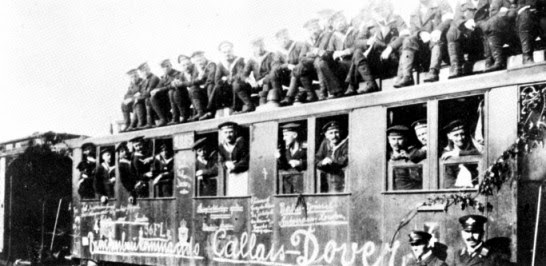
World War One German sailors mobilized by rail 

Excerpts from A Man of Peace continue ...
At a mere "Tank-station"   [i.e. the location of a water tank to replenish locomotive tenders with no civilian settlement]  below Kriesingen, on June 12, I saw probably seventy-five or a hundred locomotives (I had time to count more than seventy), most of which were of antiquated type obsolete as far as the demands of up-to-date traffic are concerned and of a kind that would have been "scrapped" in either England or America. 
Yet these were all being cared for and "doctored up". A few engineers and stokers worked round them, and I saw them run one down a long track and bring it back to another, whereupon hostlers at once began drawing its fires, and the engineer and stoker crossed over and climbed into another cab. 
"What do you suppose they are doing that for ?" I asked one of the train men with whom I had struck up an acquaintance. 
"Why," replied he with perfect frankness, "those are war locomotives." 
Reading the look of bewilderment on my face, he added, "You see, those engines are no longer good enough for heavy or fast traffic, so as soon as they become obsolete we send them to the reserve. They are all of them good enough to move troop trains, and therefore are never destroyed. They are all frequently fired up and tested in regular turn. Those fellows out there do nothing else. That is their business, just keeping those engines in order and fit for troop duty. There are dozens of such depots over Germany." 
"But how on earth could you man them in case of war ? Where would you get the engineers for so many extras ?" 
He smiled pityingly at my ignorance. 
"The head-quarters know to the ton what each one of those can pull, how fast, where the troop cars are that it will pull ; and every man that would ride behind one has the number of the car he would ride in, and for every so many men there is waiting somewhere a reserve engineer and stoker. The best locomotives would be the first out of the reserve, and so on down to the ones that can barely do fifteen kilometres per hour." 
Since that June day, Germany has proved how faithfully those thousands of reserve locomotives over her domain have been nursed and cared for, and how quickly those who were to man and ride behind them could respond.

German state railway terminal schematic
Originally from an 1885 German railway education textbook - 15 years after the Franco-Prussian War - 29 years before the Great War : A railway terminal schematic diagram as part of a standardized state railway curriculum.
 Excerpts from A Man of Peace continue ...
At this point, almost as I write, I had something explained to me over which I have at times puzzled for months. On February 14 of this year I was in Cologne, and blundered, where I had no business, into what I learned was a military-stores yard. Among other curious things were tiny locomotives loaded on flats which could be run off those cars by an ingenious contrivance of metals, or, as we call them in America, rails. Also there were other flats loaded with sections of tracks fastened on cup ties (sleepers that can be laid on the surface of the earth) and sections of miniature bridges on other flats. I saw how it was possible to lay a line of temporary railway, including bridges, almost anywhere in an incredibly short space of time, if one had the men. 
At one period of my life I was actively interested in railway construction, but had never before seen anything like this. Before I could conclude my examination I discovered that I was on verboten ground, and had to leave ; but the official who directed me out told me that what I had seen were construction outfits. The more I thought of those, afterwards, the more I was puzzled by the absence of dump cars, and that mass of smaller paraphernalia to which I had been accustomed in all the contracting work I had ever seen. 
Yet I had to remember with admiration the ingenuity of the outfit, and think of how quickly it could all be laid, transferred, re-shipped, or stored. Here before me, in a letter received from Holland but yesterday, which comes from a Hollander who was a refugee in Germany, and on August 30   [1914 - after the war had begun]  reached home after trying experiences, is the following :
Never, I believe, did a country so thoroughly get ready for war. I saw the oddest spectacle, the building of a railway behind a battle-field. They had diminutive little engines and rails in sections, so they could be bolted together, and even bridges that could be put across ravines in a twinkling. Flat cars that could be carried by hand and dropped on the rails, great strings of them. Up to the nearest point of battle came, on the regular railway, this small one. At the point where we were, it came up against the soldiers. It seemed to me that hundreds of men had been trained for this task, for in but a few minutes that small portable train was buzzing backward and forward on its own small portable rails, distributing food and supplies. 
It was great work, I can tell you. I've an idea that in time of battle it would be possible for those sturdy little trains to shift troops to critical or endangered points at the rate of perhaps twenty miles an hour, keep ammunition, batteries, &c., moving at the same rate and, of course, be of inestimable use in clearing off the wounded. A portable railway for a battle-field struck me as coming about as close to making war by machinery as anything I have ever heard of. I did not have a chance, however, to see it working under fire, for, being practically a prisoner, I was hurried onward and away from the scene.
I know of nothing more than this, coming from one whom I know to be truthful, that so adequately shows how even ingenious details had been worked out for military perfection. We shall doubtless hear, after this war is over, how well those field trains performed their work when it came to shifting troops in times of fierce pressure on a threatened point, and how it added to German efficacy. 
The reader will perhaps ask by this time, "What has all this to do with responsibility for the war ?" I answer, "When the reader was a boy and by various efforts and privations saved money enough to buy a box of tools, did he lock them up in the garret, or bury them in the cellar ? When he possessed a fine bright Billy Barlow pocket-knife, did he whittle with it ?" However, this is not an argumentative thesis, and a good witness confines himself to what he personally considers relative, and to personal events that may or may not be regarded as significant. I hold no brief one way or the other.

German narrow gauge battlefield railway
A narrow gauge German battlefield railway early in the war. As Part 3 will show, both sides made use of light railway systems in the battlefields on the Western Front.


[After observing German shore battery and naval exercises, and having been warned by a friend in late July 1914 to leave Germany immediately via Switzerland, Norton makes the following observation]

It is needless to say that I was in Berlin and packing on the following day, that immediately after I did go to Switzerland, and that still there was no open declaration of war on Germany's part. I stopped at Basle for a while, interested in that fine frontier station, and one day was amused by the extremely expressive swearing of a man who I found out was a "switchman" in the yards. He was complaining of over-work. 
"One might have an idea", he growled, "that Germany was going to war, from the way the German railways are ordering all their empty trucks returned from everywhere. Nothing but empties going home, and if anybody makes a mistake or overlooks one, there's the devil to pay !" 
I have since learned that this inflow of empty German carriages and trucks was so observable at other frontier stations, that two weeks before war was declared the German yards were swamped with this excess.

Russian Army mobilization - mind the steppes 

Slowly assembling from the vast expanse of the Russian Empire, the Czar's army is heading for East Prussia. Passenger coaches have been provided for the officers, perhaps for food service as well. Everyone else rides in the Vista-Liners.

With Russia's railways being of a 5 foot gauge (to impede invasion by rail) it will be necessary to march west from the border - unless the Germans have thoughtfully left some 4 foot 8 1/2 inch 'standard gauge' equipment sitting around for their convenience.

Technically, Germany declared war on Russia just before it declared war on Russia's ally France.

Practically, it needed the Schlieffen Plan to work in France so the victorious German army could quickly ride the rails of the German state railway east to stop the Russians.